The “11-Month Rent/Leave & License Agreement” Myth: Why It Exists & Why You Should Stop Doing It
If you have ever rented a flat in Pune, you know the drill. The broker hands you a draft, and the duration is almost always set to 11 months.
But have you ever asked “Why?”
Why 11? Why not 12? Why not 5 years?
Most people think “11 months” is a magic number that keeps them safe. It is actually a myth based on an old law that no longer benefits you in Maharashtra.
Here is the real story behind the 11-month habit and why sticking to it in 2026 might be costing you money.
1. Decoding the Legal Jargon: “Revocable Leave & License”
Before we bust the 11-month myth, you need to understand two key phrases you will find in every agreement:
“The Licensor hereby grants to the Licensee herein a revocable leave and license, to occupy the Licensed Premises…”
What does this actually mean for you?
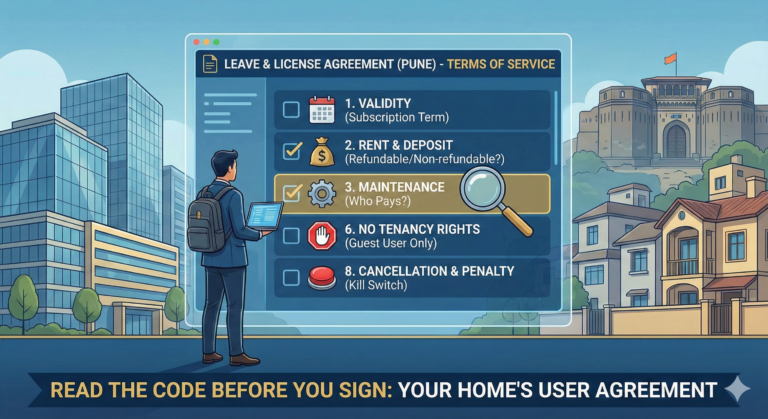
- “Revocable”: This is the most critical word. It means your permission to stay is temporary and can be cancelled. Unlike a “Tenancy” where you have strong rights to the land, a “License” is just a personal permission. The owner can revoke (cancel) this permission if you break the rules, just like a software company can revoke your user license.
- “Licensed Premises”: This confirms that you are not given “possession” of the property in the legal sense. You are given access to use a specific space (the flat) for a specific purpose (residence). You don’t own the space; you are just an authorized user.
2. The Legal Safety Net: Why Owners Don’t Need to Fear Long Leases
Many landlords insist on 11 months because they are afraid that a long-term tenant might claim ownership. This fear is outdated because of one powerful line in the modern agreement:
“The Licensor grants… a revocable leave and license… without creating any tenancy rights or any other rights, title and interest…”
What this means: This clause is the owner’s safety shield. It legally confirms that the user is merely a “Licensee” (a temporary guest with permission) and never a “Tenant” (who has land rights).
- “Revocable”: The owner retains the power to cancel the permission.
- “No Tenancy Rights”: This ensures that whether you stay for 11 months or 60 months, your legal status never changes. You cannot claim ownership or refuse to vacate.
The Verdict: Because this clause exists in every registered agreement, the “11-month safety buffer” is no longer needed. Owners are 100% safe signing for 24 or 36 months.
3. The Origin Story: Why “11 Months” Became Famous
The habit of signing 11-month agreements comes from a central law called the Registration Act, 1908.
- The Old Rule: According to Section 17 of this Act, any lease of immovable property for a period exceeding 12 months must be compulsorily registered.
- The Loophole: To avoid the hassle of going to the Registrar’s office and paying high registration fees, people started making agreements for 11 months. Since it was less than 12 months, they could just sign it on a simple stamp paper (Notary) and skip the registration.
This created the “11-Month Myth”: “If I make it 11 months, I don’t need to register it.”
4. The Reality in Pune (Maharashtra Rent Control Act)
While the “11-month loophole” might work in other states, it does NOT work in Maharashtra.
In our state, the Maharashtra Rent Control Act, 1999 (Section 55) overrides this old habit.
- The Law: It states that every Leave and License Agreement must be registered in writing, regardless of the period.
- The Catch: Whether your agreement is for 1 month or 60 months, you MUST register it with the Sub-Registrar.
The Verdict: You can no longer save money by skipping registration just because your agreement is 11 months. You have to pay the registration fee anyway.
5. Why “11 Months” is Now a Bad Financial Move
Since you have to register the agreement anyway, sticking to the old “11-month” format is actually expensive for you.
- Higher Brokerage: If your agreement ends in 11 months, you technically have to renew it (and pay brokerage again) sooner than a year.
- Rent Hikes: In an 11-month agreement, the owner can demand a rent hike before the year is even over.
- Repetitive Costs: You have to pay the “Legal & Registration Charges” every 11 months instead of once every 2–3 years.
6. The Smart Strategy: Negotiate for 24 or 36 Months
Under the current online system, you can legally register a Leave and License agreement for any duration up to 60 months (5 years).
The “Tenant’s Advantage” Strategy: Instead of 11 months, ask for a 24-month or 36-month “Period”.
- Scenario A (Old School 11 Months):
- You pay registration fees today.
- After 11 months, the agreement expires.
- You pay registration fees again for renewal.
- Total Cost: High.
- Scenario B (Smart 24 Months):
- You sign a 24-month agreement today.
- You pay registration fees once.
- You lock in the rent for the first 12 months, with a pre-decided hike (e.g., 5%) for the next 12 months.
- Total Cost: Low (You save one round of legal fees and brokerage).
Summary
- The Myth: “11-month agreements don’t need registration.” (False in Maharashtra).
- The Law: All agreements must be registered, even if they are for 1 month.
- The Advice: Stop following the herd. Since you are paying for registration anyway, make the most of it. Sign a 12, 24, or 36-month agreement to save on renewal costs and lock in your peace of mind.