Power of Attorney in Maharashtra
A Power of Attorney is a legal contract in Maharashtra that allows a Principal to nominate an Agent to manage affairs such as real estate transactions, legal disputes, and financial investments. These documents are categorised into specific, general, or time-limited types depending on the scope of authority granted. To minimise Stamp Duty costs when selling property, the state encourages appointing close relatives, as appointing non-relatives incurs significantly higher fees. While some powers only require notarisation, mandatory registration at a government office is essential for tasks involving the purchase or sale of property. Furthermore, the guidelines provide a framework for Non-Resident Indians to execute these documents abroad through Indian Consulates to manage their domestic interests. This regulatory structure ensures that both grantors and holders understand their legal obligations and the associated fiscal implications.
The Complete Guide to Power of Attorney in Maharashtra
Whether you are managing real estate, navigating court matters, or handling financial investments, you may not always be physically present to execute necessary legal duties. This is where a Power of Attorney (PoA) becomes an essential tool.
A Power of Attorney is a written contract allowing one person (the Principal or Grantor) to assign specific rights to another person (the Agent or PoA Holder). Depending on your needs, you can assign an agent to handle real estate transactions, court representation, financial management, or even grant general authority to perform any act you are legally eligible to do.
Here is everything you need to know about creating, registering, and utilizing a Power of Attorney in Maharashtra.
Types of Power of Attorney
Powers of Attorney generally fall under three broad categories:
• Specific or Special Power of Attorney: This is created for a highly specific purpose, such as renting out a particular property or representing the grantor at a sub-registrar’s office.
• General Power of Attorney: This grants broad powers to the agent, allowing them to manage existing and future properties, including buying, selling, and mortgaging. Because of the vast authority granted, it is crucial to appoint a highly trustworthy person as your agent.
• Limited Time Power of Attorney: This document is valid only for a specific duration. Once the set time expires or a specific task is finished, the PoA is automatically canceled, making it ideal for temporary needs.
Property Transactions and Stamp Duty Rules in Maharashtra
A Special PoA is frequently used by buyers and sellers who cannot be present at the sub-registrar’s office for property registration. An agent can be authorized to negotiate prices, sign sale deeds, execute cancellation deeds, apply for bank loans, and present documents for registration.
When choosing your PoA holder for selling property in Maharashtra, your relationship with the agent drastically impacts the Stamp Duty you must pay.
• Near Relatives: If you make a PoA for selling immovable property in favor of a “near relative,” it attracts very minimal fees: just Rs. 500 for Stamp Duty and Rs. 100 for Registration Fees. The government defines a near relative as a father, mother, brother, sister, wife, husband, daughter, son, grandson, granddaughter, or the parents/siblings of a spouse.
• Non-Relatives: If you grant the right to execute a property sale to someone who is not a near relative, the Stamp Duty and Registration Fees will be equivalent to the Conveyance rate. For example, in Pune Corporation areas, this could amount to a 5% Stamp Duty plus a 1% Registration Fee, 1% LBT, and 1% Metro Cess.
What if a near relative is not available? If you must use a non-relative but want to avoid the heavy Conveyance stamp duty, you can grant them limited rights. You can withhold the right to sign (execute) the document and only grant them the power to present the document and admit the execution at the Registration Office. The actual property owner must sign the document in front of the PoA holder. This limited PoA will only attract the Rs. 500 Stamp Duty and Rs. 100 Registration Fee. Additionally, any PoA made for a purpose other than selling property also only requires a Rs. 500 Stamp Duty.
Notarization vs. Registration
Understanding when to notarize versus when to register your PoA is critical:
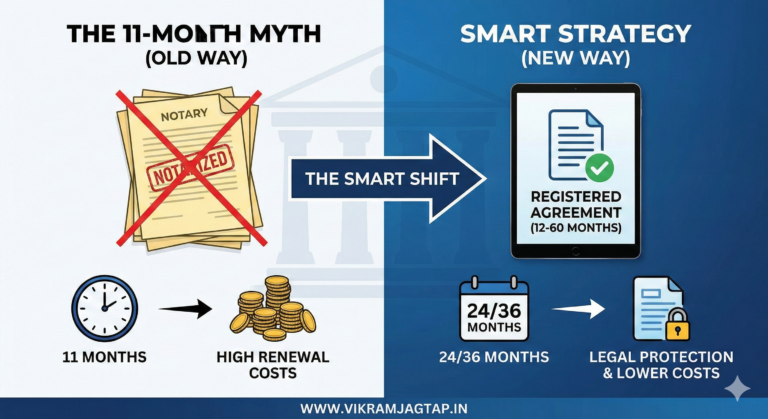
• The Difference: In a notarization, a Notary verifies the parties and notes the details in their register. In a registration, the Grantor, the Holder, and two witnesses must visit the registration office, and a copy of the PoA is permanently stored in the Government Database.
• When Registration is Compulsory: You must register the PoA if it is being used to buy or sell property, sign home loan documents, take possession from a builder, or admit the execution of a document involving property transfer, etc.
• When Registration is Optional: Registration is not legally required for executing Leave and License Agreements, signing society documents, or handling court matters, etc.
Special Rules for Non-Resident Indians (NRIs)
If you are an NRI, you can execute a PoA from outside India to buy/sell property, manage rentals, or oversee investments. The process is as follows:
1. Prepare the draft, affix a photograph, attach your passport copy and address proof, and sign all pages.
2. You must be physically present at the Indian Embassy/Consulate counter to sign the document on plain paper, which must then be authenticated by the Indian Embassy/Consulate in your country of residence.
3. Once sent to Maharashtra, the stamp duty must be paid within the prescribed time limit, and the PoA Holder must get the document notarized or registered according to state processes. Notably, there is an exemption for compulsory registration if the PoA Grantor is living outside of India.