Online Rent Agreement-Leave & License Registration in Pune
If you live in Pune—whether you’re an IT professional in Hinjawadi or a family in Kothrud—you’ve likely heard everyone use the term “Rent Agreement.”
But have you ever actually read the document you sign?
If you look closely at the top of the paper, it never says “Rent Agreement.” It says “Leave and License Agreement”.
Why the difference? And does it matter?
In simple terms: A “Rent Agreement” is like buying a software CD in the 90s—you own a copy forever. A “Leave and License” is like a Netflix subscription—you are just a user with a temporary login.
In Maharashtra, landlords prefer the “Subscription” model (Leave and License) because it legally protects them from tenants who refuse to leave. For you, the tenant, it means you need to understand exactly what you are signing up for.
Here is your “Terms of Service” (ToS) decoded into plain English.
1. The Validity Period (Subscription Term)
The agreement explicitly grants you a “revocable leave and license” for a fixed period, usually 11 or 24 months (legally agreement can be made from 1 month to 60 months). This defines your “Login Session.”
Legally, you are not a “Tenant” with land rights; you are a “Licensee” with permission to enter. The key word here is “Revocable,” which means your access can be cancelled if you violate the rules, just like an account ban.
2. The Commercials (Pricing Model)
This section outlines your financial commitment. You agree to pay a monthly Compensation (Rent), which typically must be paid within the first five days of every month.
You also pay a Deposit. This is your Security Token.
- Usually, this is “Interest-free Refundable”, meaning you get the principal back when you leave.
- The agreement also has an option for an “Interest-free Non-refundable” deposit. Always verify this word carefully! If “Non-refundable” is selected, that money is gone forever, treated as a premium rather than a deposit.
3. Maintenance & Taxes (The Hidden Costs)
This is often the most confusing part. Who pays the Society Bill?
The agreement usually offers two options. In most standard contracts, the Owner (Licensor) pays the property taxes and society maintenance charges, while you only pay for your personal usage like electricity and gas.
However, some agreements tick the other box, making You (Licensee) responsible for maintenance charges. Always double-check this clause; if the wrong box is ticked, your monthly cost could go up by ₹3,000–₹5,000!
4. “Acceptable Use Policy” (AUP)
Just like software has an acceptable use policy, so does your flat. You are permitted to use the premises strictly for residential purposes. You cannot run a commercial server farm, a cloud kitchen, or a coaching class from home.
It also includes a “Nuisance” clause. You must not do anything that annoys the other occupants of the building or violates government laws. If you play loud music at 2 AM and the Society complains, you are technically in breach of contract.
5. Alterations (The “Read-Only” Mode)
The apartment is essentially in “Read-Only” mode. You cannot make any “alteration or addition” to the construction without previous written consent from the owner.
This means you cannot drill extensive holes, break down a wall, or change the flooring. If you need to install a heavy AC unit or drill for Wi-Fi cabling, get a quick approval (even a WhatsApp message) from the owner first.
6. No Tenancy (You Are a Guest, Not an Admin)
This is the most critical security clause for the owner. The agreement states clearly that you shall not claim any “tenancy rights”.
This means you cannot sub-let the flat (rent out the extra bedroom to your friend) because the license is personal to you. You also cannot mortgage the house or claim ownership rights, no matter how long you stay.
7. Inspection (Audit Rights)
The Owner retains “Admin Access.” They have the legal right to enter and inspect the premises to check its condition.
However, they must give you “Reasonable Notice”. They cannot just barge in at 7 AM on a Sunday without warning.
8. The Lock-in Period (Mandatory Subscription)
Legal Clause: “Both parties have agreed to set a lock-in period of 12 months… neither shall vacate… if licensee leaves, he shall pay license fee for remaining period.”
This is a Hard Commitment. Unlike a standard month-on-month plan, this is like a 12-month contract with an Internet Service Provider (ISP).
- The Restriction: You are legally forbidden from leaving the flat during the first 12 months.
- The Tenant’s Penalty: If you leave in Month 6 (e.g., you get transferred to Bangalore), you must pay the rent for the remaining 6 months to the owner. You cannot just give notice and walk away.
- The Owner’s Penalty: The clause says the owner cannot ask you to leave either. If they force you out, they must compensate you for “loss and inconvenience” (though unlike your penalty, the exact amount for them isn’t fixed, which puts you at a slight disadvantage).
Be very careful with this clause. If your job is unstable or transferrable, negotiate to remove the Lock-in period or reduce it to 6 months or remove it entirely.
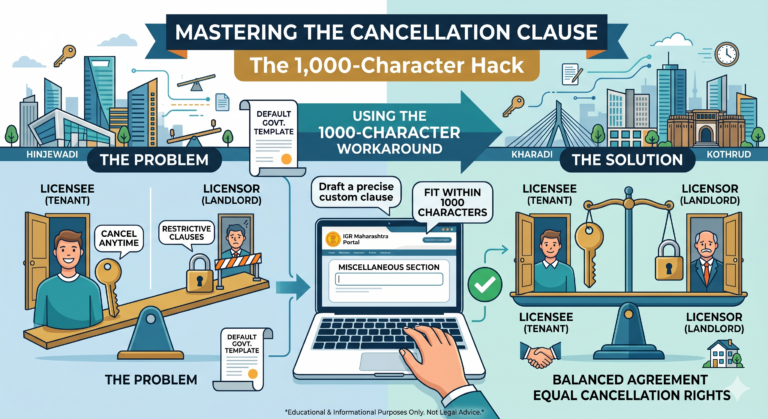
9. The “Kill Switch” (Cancellation)
How do you end the subscription early if there is no lock-in clause?
If you are the Tenant: You have more flexibility. You can choose to vacate the premises by simply giving a one-month written notice to the owner, even without a specific reason.
If you are the Owner: You cannot just wake up and ask the tenant to leave. According to this specific online draft, you can only serve a one-month notice if the tenant defaults on payment, breaks a rule, or if the law changes and requires the cancellation of the agreement.
10. The Penalty for Overstaying (Squatting)
What happens if your agreement expires on the 31st and you are still there on the 1st without renewing?
The agreement empowers the owner to charge you double the daily rent as damages for every extra day you stay. Furthermore, they have the right to remove your belongings without needing a court order.
11. Furniture & Appliances (The Hardware Inventory)
Legal Clause: “The said premises is having the Furniture and Appliances mentioned in the Schedule II… repaired by Licensee at its own cost subject to normal wear and tear.”
This is your “Asset Register.” Most furnished flats come with a specific list of items (ACs, Geysers, Sofa, TV).
- Schedule II is Critical: Always verify this list! If “1 Microwave” is listed in Schedule II but isn’t actually in the kitchen, you could be accused of theft when you leave. Conversely, if you are promised a Washing Machine, ensure it is written here.
- Your Responsibility: You are the “System Admin” for these devices. If you break the TV screen, you pay for it.
- The “Wear and Tear” Defense: This is your safety net.
- Scenario A: You drop the AC remote and it breaks. -> You Pay (Damage).
- Scenario B: The AC stops cooling because the compressor is 10 years old. -> Owner Pays (Normal Wear and Tear).
Action Item: Before signing, switch on every appliance (AC, Geyser, Fans) to check if they work. If something is broken, mention it in the Miscellaneous section immediately so you aren’t blamed for it later.
12. Registration (Who Pays the Government?)
“This Agreement is to be registered and the expenditure… shall be borne by…”
In Maharashtra, you cannot just sign on a ₹100 stamp paper. The agreement must be officially registered with the government to be valid.
Who Pays? the government portal actually allows you to choose one of three options:
- Licensee pays: You pay the full amount.
- Licensor pays: The owner pays.
- Shared Equally: You split the cost 50-50.
If you negotiated with the owner to split the cost (which is fair), make sure the draft selects “Both will pay equally”.
13. Miscellaneous (The “Custom Rules” Section)
Legal Clause: “Miscellaneous” (Text box with 1000 character limit).
The Reality: Most standard online drafts are rigid, but this section is your Wildcard. It is a blank text box where you can add specific rules that you and the owner agreed upon verbally.
What You Should Write Here: Don’t leave this blank! Use it to clarify the grey areas:
- Painting Policy: “The Licensee shall not be liable to pay painting charges at the time of vacating.” (Crucial, otherwise owners often deduct one month’s rent for painting).
- Parking Slot: “One covered car parking slot bearing No. A-102 is allotted to the Licensee.”
- Appliance List: “Flat includes 2 ACs, 1 Geyser, and 1 Modular Kitchen Chimney.”
- Pet Policy: “The Licensor has no objection to the Licensee keeping a pet dog/cat.”
If the owner promised you something (like “I will fix the leakage next week”), write it down here. If it’s not in the Miscellaneous section, it doesn’t exist legally.
In Pune’s fast-paced rental market, the Leave and License Agreement is the standard because it is fast, temporary, and legally clear.
Your Checklist Before Signing:
- Check the “Maintenance” clause: Ensure the Owner is paying the society bill.
- Verify the Rent amount: Is it fixed or does it increase after 11 months?
- Confirm the Deposit mode: Ensure your Cheque/UTR number is correctly recorded in the agreement.
- Check the notice period.
- Check if there is any lock-in period mentioned.
- Check the list of furniture and Appliances.
- Check who is paying for the online registration of the Leave and License Agreement.
Disclaimer: This article is for informational purposes only. Always consult a legal professional before signing any legal document.