FAQ – Power of Attorney in Pune, Maharashtra: Rules & Stamp Duty Explained
Power of Attorney is one of the most misunderstood documents in Pune’s property market. The questions below are the most frequently asked by residents, NRIs, buyers, and sellers.
General Questions About Power of Attorney
What is a Power of Attorney (POA)?
A Power of Attorney is a legal document by which one person (the principal) authorises another person (the agent or attorney holder) to act on their behalf in specified matters. In the context of Pune property transactions, it is used when the principal cannot be physically present, for example, an NRI living abroad, an elderly person who cannot travel, or someone managing multiple transactions simultaneously.
What is the difference between a General Power of Attorney (GPA) and a Special Power of Attorney (SPA)?
A General Power of Attorney (GPA) grants the agent wide-ranging powers to act across many matters, property transactions, banking, tax filings, legal proceedings, and more. It does not expire upon completion of any single task.
A Special Power of Attorney (SPA) is strictly limited to one specific transaction or task, for example, “to appear before the Sub-Registrar, Haveli No. 7, Pune and execute the Sale Deed for Flat No. 301 in [Building Name], Baner.” Once that task is completed, the SPA automatically terminates. Another example is that a Power of Attorney can be granted only for leave and license agreement-related work for some specific property or multiple properties, but the authority is limited to only leave and license agreement work. For property transactions in Pune, an SPA is always preferred. It reduces the risk of misuse, is more clearly scoped, and is readily accepted by Sub-Registrar offices and banks.
Can a Power of Attorney holder sell property on behalf of the principal in Pune?
Yes, but only if the POA explicitly and specifically grants the power to sell that particular property and to appear before the Sub-Registrar to execute and register the Sale Deed. Vague or general language is not sufficient. The Sub-Registrar offices in Pune’s Haveli jurisdiction actively scrutinise the language of the POA before accepting the agent’s execution of a Sale Deed. If the power to sell is not explicitly stated, the transaction will be rejected.
Does a POA transfer ownership of property to the agent?
No. A Power of Attorney never transfers ownership. It is an authorisation document only. The agent acts as a representative of the principal. Ownership transfers only when a properly stamped and registered Sale Deed (or other conveyance document) is executed. This is a critical distinction: a GPA in your favour does not make you the owner of a property. Only a registered conveyance deed does.
What are the different types of POA used in Pune property transactions?
The most common types used in Pune are:
- Special Power of Attorney (SPA): for one specific property transaction or work.
- General Power of Attorney (GPA): for broad management of a person’s affairs, including multiple properties.
- Development Agreement cum Power of Attorney: given by a landowner to a builder, authorising the builder to develop the land and sell units to third-party buyers.
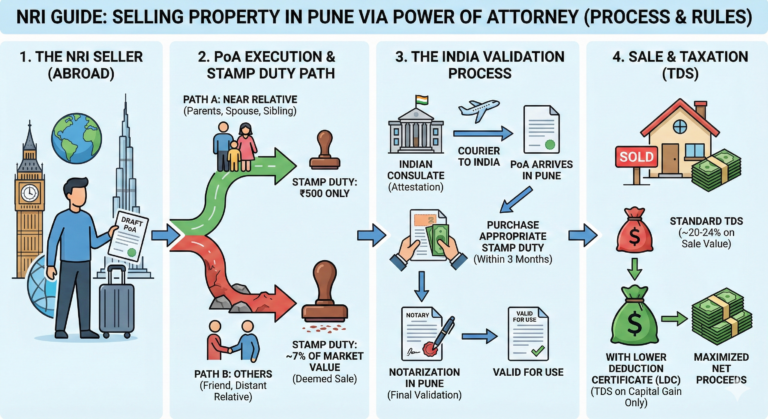
- NRI Power of Attorney: executed abroad, adjudicated in India, used for managing, selling, buying, or renting property or other affairs from outside the country.
Stamp Duty on Power of Attorney in Pune
What is the stamp duty for a Power of Attorney in Pune?
Stamp duty on a POA in Pune is governed by Article 48 of Schedule I to the Maharashtra Stamp Act, 1958. There are two possible outcomes:
- ₹500: if the POA is for any purpose other than selling immovable property, regardless of who the agent is; or if it is given to a “near relative” to sell property without any consideration (i.e., no payment made for the arrangement).
- Equivalent to conveyance stamp duty (currently 4–5% of property value + 1% LBT + 1% Metro Cess in Pune): if the POA authorises a non-near-relative to sell immovable property on the principal’s behalf. If property is located in Rural areas the stamp duty is 4% + 1% LBT, and if property is located at corporation are the stamp duty will be 5% + 1% LBT and 1% Metro Cess. These charges are applicable of the Ready Reckoner rate of the property.
The binary nature of this rule is what generates the most confusion and the most expensive mistakes in Pune’s property market.
Who qualifies as a “near relative” for the purpose of the ₹500 stamp duty concession?
The Maharashtra Stamp Act defines “near relative” strictly for this purpose as: father, mother, brother, sister, wife, husband, son, daughter, grandson, granddaughter, and the father, mother, brother, or sister of the spouse. This list is exhaustive; it is not expanded by interpretation. If the person you want to appoint is not on this list, they are not a “near relative” under the Act.
Does an uncle or cousin count as a “near relative” in Maharashtra?
No. None of the following qualify as “near relatives” for stamp duty concession purposes under the Maharashtra Stamp Act: uncle, aunt, nephew, niece, cousin, or grandparents’ siblings. Appointing any of these individuals as agent to sell your property will attract stamp duty equivalent to a full Sale Deed — not ₹500.
If I give POA to a friend to sell my flat in Pune, how much stamp duty will I pay?
Full conveyance-level stamp duty. For a property in Pune Municipal Corporation limits, this is approximately 5% stamp duty + 1% Metro Cess + 1% Local Body Tax = 7% of the property’s Ready Reckoner value, plus registration fees. On a ₹80 lakh flat, that is approximately ₹5.6 lakh in stamp duty on the POA alone, before you pay stamp duty on the Sale Deed itself. This is why appointing a non-relative as POA holder for property sales requires very careful planning.
What is the stamp duty on a POA that is not for selling property — such as for rent collection or banking?
Only ₹500, regardless of who the agent is. If your POA is limited to tasks such as collecting rent, appearing before a bank, attending society meetings, paying property taxes, managing a tenant, or representing you in RERA proceedings and does not authorise the sale of immovable property, the stamp duty is ₹500 irrespective of whether the agent is a relative or not.
Is there a separate stamp duty for a Development Agreement cum POA given to a builder in Pune?
Yes. A Development Agreement cum Power of Attorney is a composite document; it contains both the Development Agreement and the POA as part of one instrument. The stamp duty is not simply ₹500. It is calculated based on the higher of: the stamp duty on a Development Agreement (which is linked to the value of development rights), or the stamp duty on a conveyance, whichever is applicable. This document is separately adjudicated and requires legal expertise to structure correctly to avoid overpayment or underpayment of stamp duty.
What happens if the stamp duty on a POA is underpaid or the document is on insufficient stamp paper?
Under Section 34 of the Maharashtra Stamp Act, 1958, an insufficiently stamped document is inadmissible in evidence and cannot be acted upon until the deficiency is rectified.
Under Section 33, any officer, including the Sub-Registrar, who receives an insufficiently stamped document in the course of their official duty is obligated to impound it. The Sub-Registrar will not proceed with the transaction until the stamp duty deficiency is resolved.
Once impounded, the document is dealt with under Section 39. The Collector will require payment of the deficit stamp duty together with a penalty calculated.
Can stamp duty on a POA be paid online in Maharashtra?
Yes and No, if parties want to register the PoA, the Stamp duty can be paid through the GRAS (Government Receipt Accounting System) portal at gras.mahakosh.gov.in. E-stamp certificates are generated under the Maharashtra Stamp Act and are accepted at all Sub-Registrar (Haveli) offices in Pune. Always keep the GRAS payment challan; you must present it at the Sub-Registrar’s office along with the document.
If parties want to notarize the document, the online challan is not acceptable; in this case, parties need to purchase a non-judicial stamp paper in hard form, it can be purchased from any authorised stamp vendor.
What is the stamp duty on a POA where the principal is in another state but the property is in Pune?
Stamp duty is payable in Maharashtra, specifically in the state where the document will be used, determined by the situs of the property. Even if the principal signs the POA in Delhi or Hyderabad, if the document relates to a property transaction in Pune, it must be stamped according to Maharashtra Stamp Act rates.
Under Section 18(1) of the Maharashtra Stamp Act, 1958, an instrument executed outside Maharashtra but chargeable with duty in this State must be stamped within 3 months of it being first received in Maharashtra. If the required stamp denomination is not available commercially, Section 18(2) allows the document to be taken to the Collector within that same 3-month period for stamping.
Registration of Power of Attorney in Pune
Is registration of a POA mandatory in Pune, or is notarisation sufficient?
It depends on the purpose of the POA.
- Notarisation alone is sufficient for matters like leave and license, rent agreement registration, rent collection, banking, attending society meetings, filing applications, and representing in regulatory proceedings.
- Registration at the Sub-Registrar’s office is compulsory under Section 17 of the Registration Act, 1908, when the POA authorises the agent to execute a Sale Deed or any other document that transfers, creates, or extinguishes rights in immovable property.
In Pune, the Haveli Sub-Registrar offices will refuse to register a Sale Deed executed by an agent unless the agent’s authority, the POA itself, is a registered document. A notarised POA will be rejected at this stage.
Which Sub-Registrar (Haveli) office in Pune should I go to for registering a POA?
As per the latest guidelines, you can register a Power of Attorney (POA) at any Sub-Registrar office across the entire Pune District, provided the grantor has a valid Pune residence address proof.
Since jurisdiction restrictions for document registration have been relaxed within the district, you are no longer tied to a specific local office based on your neighborhood. You can choose whichever location is most convenient for you and the grantor to complete the biometric verification and execution.
Does both the principal and the POA holder need to be physically present for registration in Pune?
In Pune, a Power of Attorney (POA) can be registered as a single-party document, meaning the physical presence of the POA holder (agent) is completely optional. For successful registration, it is mandatory that the principal (grantor) is physically present to admit execution before the Sub-Registrar, along with two adult witnesses carrying valid photo ID.
While both the principal and the POA holder can choose to jointly execute and register the document together, the law does not compel the holder to be there. As long as the grantor and the witnesses are present with their original identity and address proofs, the registration can be fully completed.
What documents are needed to register a POA at a Pune Haveli Sub-Registrar office?
- Original POA signed by all parties
- GRAS e-payment challan or e-stamp certificate as proof of stamp duty payment
- Original photo ID of the principal and POA holder (Aadhaar card and PAN card)
- Passport-size photographs of the principal and the agent
- Two witnesses with original Aadhaar cards
- Document Handling Charge (DHC) payment receipt: ₹20 per page of the document
- If the POA relates to a specific property, the property description page (property card, 7/12 extract or Index II) may be required by some Haveli offices for verification
What is the registration fee for a POA at a Pune Sub-Registrar office?
The registration fee for a Power of Attorney is ₹100 when the stamp duty is ₹500 (near relative or non-property POA). When the POA attracts full conveyance-level stamp duty, the registration fee is 1% of the property’s Ready Reckoner value, subject to a maximum cap of ₹30,000.
How long does the POA registration process take at Pune Haveli offices?
At most Haveli offices in Pune, the registration of a straightforward POA takes around 1 hour. For simple POAs with no property valuation disputes, same-day processing is common. The registered original document is generally available for collection within 1 to 2 working days after registration. Always take an appointment through the iSarita 2.0 / eStepin portal before appearing — walk-ins are no longer systematically accepted at several Haveli offices.
Can a POA registered in another state be used for a property transaction in Pune?
Yes, with conditions. A POA registered in another state is valid in Maharashtra, but it must be adequately stamped according to Maharashtra Stamp Act rates.
Can the POA registration be done online in Pune without visiting the Sub-Registrar’s office?
Not fully. Stamp duty payment can be done online via GRAS. Document preparation can be done through the PDE 2.0 (Property Document Entry) system. Appointments are booked through eStepin 2.0. However, the actual registration, the step where the Sub-Registrar records the document, captures biometric data, and the principal admits execution, requires physical presence at the Haveli office. There is currently no fully online substitute for this final step in Maharashtra.
NRI Power of Attorney for Property in Pune
How does an NRI create a valid Power of Attorney for property in Pune from abroad?
The process has six steps that must be followed in sequence:
- Draft to Indian legal standards: include the Pune property’s Survey/CTS number, full address, and PAN and Aadhaar card details of both parties. The language must specify every power being granted. Vague drafting is the most common reason for Sub-Registrar rejection.
- Sign in wet ink on physical paper, not digitally. Digital or e-signatures are not valid for immovable property POA in India under current law.
- Execute before a Notary Public, Indian Embassy, or Consulate in the country of residence.
- Apostille or Consular Attestation: for countries that are members of the Hague Apostille Convention (USA, UK, Australia, UAE), an Apostille stamp suffices. For non-member countries, attestation by the Indian Consulate or Embassy is required. When in doubt, consular attestation is safer as it is universally accepted in Pune.
- Courier the original to Pune: only the original physical document is accepted. Keep the airway bill/tracking receipt, as it establishes the date of arrival in India.
- Purchase non-judicial Stamp Paper of Rs. 500/- and attach to the original PoA within 3 months.
- Notarization in Pune: Visit the local authorized notary and get the PoA notarized within 3 months.
What stamp duty does an NRI pay on a POA for Pune property?
Exactly the same rules as any other principal, Article 48 of the Maharashtra Stamp Act applies equally to NRIs. If the PoA is made for selling a property and the agent is a “near relative” (parent, sibling, spouse, child, or grandchild or father, mother, brother, sister of a spouse), stamp duty is ₹500. If the agent is anyone else- a trusted friend, a property consultant, or even a non-near-relative family member- stamp duty is equivalent to full conveyance rates (6 to 7% of the Ready Reckoner value of the Pune property).
Rs. 500/- for a Power of Attorney made for other purposes given to anyone.
Can an NRI give a POA to a non-relative (such as a property lawyer or friend) in Pune without paying full conveyance stamp duty?
Not directly under the current Maharashtra Stamp Act, if the POA authorises the agent to sell immovable property. The full conveyance duty applies regardless of the principal being an NRI or a resident. Some NRIs explore structuring the POA to exclude direct selling power, but this requires careful legal advice. There is no blanket exemption for NRIs from this rule.
Can an NRI give a POA to another NRI who also lives abroad?
Yes, legally there is no bar. The POA document itself must still comply with all Indian legal requirements — proper execution, attestation, adjudication, and registration. However, because the Sub-Registrar office in Pune requires the agent to be physically present for registration of any property transaction, the second NRI would need to either travel to Pune or appoint a sub-agent in India (if the POA permits sub-delegation) to carry out the actual transaction.
Does an NRI’s POA need to be on Indian stamp paper, or can it be on plain paper abroad?
The NRI (principal) can simply print the POA text on standard, plain white paper. To make it legally valid, the execution must follow these steps before it is sent to India:
Attestation: The signed plain-paper POA must be either notarized by a local Public Notary in that country, attested by the Indian Embassy/Consulate, or apostilled (if the country is a member of the Hague Convention).
Signing: The NRI signs the document in the presence of an authorized official.
Can a digital or electronically signed POA be used for property transactions in Pune?
No. Under current Indian law, specifically the Information Technology Act, 2000, read with the Registration Act, 1908, electronically signed or digitally signed documents are not valid for transactions involving immovable property. The POA must be signed in wet ink on physical paper. This applies to both resident and NRI principals.
What happens to the POA if the NRI principal dies before the property transaction in Pune is completed?
The Power of Attorney terminates automatically and immediately upon the death of the principal, under Section 201 of the Indian Contract Act, 1872. Any transaction that the agent executes after the principal’s death is void in law and can constitute criminal fraud. The agent must stop acting immediately upon becoming aware of the principal’s death. The property will then need to be dealt with through succession, either by probating the Will or through the legal heirs applying for a Succession Certificate or Letters of Administration.
Should a buyer make the sale payment to the POA holder, or directly to the NRI seller?
Payment should go directly to the NRI seller’s NRO or NRE account in India, never to the POA holder personally. The POA holder’s role is to execute documents on behalf of the NRI; they have no personal entitlement to the sale proceeds. Paying the POA holder directly creates an additional legal and tax complication and may constitute misappropriation if the holder retains the funds. The POA document should also ideally specify that the agent is not authorised to receive sale proceeds; all payment instructions should go directly to the seller’s designated bank account.
GPA-Based Property Sales in Pune: Risk & Validity
Is it safe to buy a property in Pune that is being sold through a GPA?
Yes and no, not if the GPA alone is the basis of the seller’s title. A General Power of Attorney is not an instrument of property transfer. Only a registered conveyance deed (Sale Deed, Gift Deed, etc.) transfers title. A GPA sale, where the buyer gets the GPA but no registered Sale Deed, does not give a marketable title and is legally risky.
Yes – if the PoA Holder presents all other documents such as Index II, earlier Sale Deeds, Property Cards, etc., which show the PoA Grantor as an owner of the property.
What are the practical risks of buying a GPA property in Pune?
- No marketable title: The original owner remains the title holder in all government records, including the Property Card (Satbara / CTS).
- Revocability: The original owner can revoke the GPA at any time (unless it is a registered irrevocable POA with valid consideration, which has limited enforceability). Upon revocation, you lose your claimed right.
- Dual sale risk: The original owner can execute a fresh registered Sale Deed to a second buyer. That registered Sale Deed will take priority over your GPA transaction under Section 48 of the Transfer of Property Act.
- No bank financing: No bank or housing finance company in Pune will sanction a home loan against a GPA-only property. The title is defective.
- Resale impossibility: The same problem continues when you try to sell; the next buyer faces the same title defect, and the property effectively becomes illiquid in the formal market.
When is a POA-assisted property transaction in Pune fully valid and legal?
A POA is a valid and standard tool in property transactions when used correctly as an authorisation instrument, not as a title transfer mechanism. Valid uses include:
- An NRI abroad gives a SPA to their father in Pune to sign and register a Sale Deed on their behalf.
- An elderly or ill owner gives a registered POA to their child to appear at the Haveli office and complete registration of a Sale Deed that the owner has already signed.
- A landowner gives a Development Agreement cum POA to a builder to develop the land and execute Sale Deeds with flat buyers.
In every valid case, the POA is only the authorisation mechanism. Ownership still transfers through a properly stamped and registered Sale Deed, not through the POA itself.
Can the original owner revoke the GPA after the buyer has paid money?
A GPA is generally revocable unless it is an irrevocable power of attorney given for consideration and coupled with an interest under Section 202 of the Indian Contract Act. Even “irrevocable” POAs can be challenged. If the original owner revokes the GPA after you have paid money, your remedy is a civil suit for specific performance or recovery of money, not ownership of the property. The revocation itself is legally effective regardless of the money paid. This underscores why GPA-based property purchases are dangerous.
Will a bank in Pune give a home loan on a GPA-based property?
No. All major banks and housing finance companies- HDFC, SBI, ICICI, Axis, LIC Housing Finance follow RBI and NHB guidelines that require clear and marketable title for mortgage. A GPA-only chain of title is treated as defective. No home loan will be sanctioned on such a property. This directly impacts your resale value and liquidity when you eventually want to sell.
Drafting a Power of Attorney for Pune Property Transactions
What specific clauses must a POA include?
In Pune, a POA for property transactions must include:
- Full name, address, Aadhaar number, and PAN of the principal
- Full name, address, Aadhaar number, and PAN of the agent
- Precise property description: Survey number (for agricultural/NA land) or CTS number (for city survey property), Hissa number, registered plot/flat address, building name, floor, unit number
- Explicit power to appear before and admit execution at the Sub-Registrar’s office
- Explicit power to sign the Sale Deed, Agreement for Sale, or relevant document on the principal’s behalf
- Power to pay stamp duty and registration fees if required
- For NRI sellers: explicit power to comply with TDS obligations under Sections 195/197 of the Income Tax Act, and to sign Form 15CA and 15CB
- Any restrictions on scope (e.g., limited to this transaction only, no power to sub-delegate)
Can one POA appoint multiple agents in Pune?
Yes. A Power of Attorney can name more than one agent. The document must specify clearly whether they are to act jointly (both must act together for every decision), severally (either can act independently), or jointly and severally with specific role divisions. For complex family arrangements, particularly where one NRI wants both a parent and a sibling to manage different aspects of their Pune property, a well-drafted joint-and-several POA with clear role allocations is advisable.
Can a POA holder further delegate their authority to another person (sub-delegation)?
Only if the original POA explicitly permits sub-delegation. The law does not imply a right to sub-delegate. If the original POA is silent on sub-delegation, the agent cannot appoint a sub-agent with binding authority on the principal. Any sub-delegation without this express authority is invalid, and the sub-agent’s actions would not bind the principal.
Can a single POA cover multiple properties in Pune?
Yes. A single POA can cover multiple properties, provided each property is specifically identified in the document with its individual Survey/CTS number, address, and other particulars. A generic description like “all properties I own in Pune” is legally weak and may not be accepted by the Sub-Registrar for specific property transactions. Name each property individually.
Should the POA include the power to receive sale proceeds?
This depends on the transaction. For a resident principal who simply cannot attend registration but is otherwise managing the transaction, it may be acceptable. For NRI transactions, we specifically advise against including the power to receive sale proceeds in the POA given to any agent. The NRI seller’s bank account details should be specified directly in the Sale Deed so that payment flows to the seller without passing through the agent. This reduces the risk of misappropriation and avoids complications under FEMA and the Income Tax Act.
Revocation, Validity, and Termination of POA in Pune
How long is a Power of Attorney valid in Maharashtra?
A POA does not have a fixed statutory expiry period in Maharashtra unless the document itself specifies one. It remains valid until:
- The principal expressly revokes it
- The end date mentioned in the document is reached (if one was specified)
- The principal dies
- The principal becomes permanently of unsound mind
- The agent dies or becomes incapacitated
- The specific task in an SPA is completed
There is no automatic expiry after 1 year or 3 years. A POA remains effective until one of the above events occurs.
How do I cancel or revoke a registered Power of Attorney in Pune?
Follow these steps in order:
- Draft a Deed of Revocation of Power of Attorney formally cancelling the original POA, specifying its date and registration details.
- Execute the Revocation Deed before two witnesses.
- Register the Revocation Deed at the same Sub-Registrar (Haveli) office where the original POA was registered. Registration of the revocation is essential; it creates a public record.
- Serve written notice of revocation on the agent immediately by registered post and email if possible. Keep the postal receipt.
- Notify all third parties who were relying on the original POA: banks, builders, co-operative housing societies, and any pending transaction parties.
Is an “irrevocable” Power of Attorney actually irrevocable in Maharashtra?
In most cases, no. Under Section 202 of the Indian Contract Act, 1872, a POA becomes irrevocable only when it is given as security for the performance of a duty or is coupled with an interest. In standard property transactions in Pune, most “irrevocable” GPA clauses do not meet this legal standard and can be challenged in court. Buyers who rely on an “irrevocable” GPA as a substitute for a registered Sale Deed are taking a significant legal risk.
Can a Power of Attorney in Pune be challenged if the principal claims they signed under duress or undue influence?
Yes. A POA, like any other contract, can be avoided by the principal if it was obtained by coercion, undue influence, fraud, or misrepresentation under Sections 14 to 18 of the Indian Contract Act, 1872. Courts in Pune can set aside POAs in cases involving elderly or vulnerable principals who signed documents without understanding their contents. A third party who relied on the POA in good faith and without notice of the defect may have some protection, but this is a factual determination; it creates uncertainty in the transaction.
What happens if the POA holder misuses the authority granted in Pune?
A POA holder who acts beyond the scope of the POA, or uses it for personal gain at the principal’s expense, is personally liable to the principal for damages under the law of agency (Sections 211–221 of the Indian Contract Act). If the misuse amounts to criminal breach of trust or fraud, it can also attract prosecution under Bharatiya Nyaya Sanhita, 2023. The principal can also file a civil suit for an injunction to prevent further misuse and for recovery of any losses. This is why careful selection of the agent and restriction of the POA’s scope through an SPA is strongly recommended.
Cost, Process, and Practical Questions About POA in Pune
What is the total cost of getting a Power of Attorney registered in Pune?
The total cost depends on the category of POA:
| POA Category | Stamp Duty | Reg. Fee | DHC (approx.) |
|---|---|---|---|
| Non-property POA given to any agent | ₹500 | ₹100 | ₹40 per page |
| Property-selling POA given to near relative | ₹500 | ₹100 | ₹40 per page |
| Only right to admit the execution of conveyance deed given to any agent | ₹500 | ₹100 | ₹40 per page |
| Property-selling POA given to non-near-relative | 6–7% of RR value | 1% of RR value (max ₹30,000) | ₹40 per page |
Add professional drafting and legal advice fees, which typically range from ₹3,000 to ₹10,000 in Pune depending on the complexity of the document and the transaction involved.
How do I book an appointment at a Pune Haveli Sub-Registrar office for POA registration?
Appointments at Pune’s Haveli Sub-Registrar offices are booked through the eStepin 2.0 portal, which is part of Maharashtra’s IGR (Inspector General of Registration) digital system. The document must also be prepared in the PDE (Property Document Entry) format before the appointment. Walk-in registrations are not systematically accepted at most Haveli offices in Pune. Prepare and upload the document, pay stamp duty via GRAS, and book a time slot through eStepin before visiting the office.
What is the “Document Handling Charge” (DHC) for POA registration in Pune?
The Document Handling Charge is a per-page fee of ₹40 per page of the document. This fee covers the handling and scanning of the document into the government’s records. For a typical 5–8 page POA, the DHC is between ₹200 and ₹320. This is separate from and in addition to stamp duty and registration fees.
How long does it take to collect the registered POA from a Pune Haveli sub-registration office?
After the Sub-Registrar registers the document and returns it, the registered original is generally available for collection within 1 to 2 working days. Some offices notify via SMS when the document is ready. The original registered document (with the Sub-Registrar’s endorsement) is the operative instrument; always collect and preserve it carefully.
Can a physically unwell or bedridden person who cannot travel give a POA in Pune?
Yes. A physically unwell or bedridden person who cannot travel can absolutely execute and register a POA in Pune without visiting the office.
If the POA only needs to be notarized, a Notary Public can visit the principal’s residence or hospital room to witness the execution.
If the POA must be registered (which is mandatory in Maharashtra for real estate transactions), the law provides a special home-visit facility:
The Visit: Upon verification and payment of the prescribed special visiting fees (as outlined under the Maharashtra Registration Rules), the Sub-Registrar or a deputed registration officer will personally visit the principal’s residence or hospital in Pune to complete the process capture the photographs, and register the POA.
The Law: Under Section 31 and Section 38 of the Registration Act, 1908, a person who cannot travel due to severe illness or bodily infirmity is legally exempt from attending the Sub-Registrar’s office.
The Pune Procedure: Along with the application, a formal medical application, accompanied by a valid medical certificate from a registered medical practitioner stating the principal’s physical condition, must be submitted to the concerned Sub-Registrar (Haveli) office.
I need a POA for my Pune flat but I live in another city in India (not abroad). Can I register it in my city?
Yes. A POA can be registered at any Sub-Registrar office in India where the principal resides. However, if the POA is to be used for a property transaction in Pune, it should be adequately stamped under the Maharashtra Stamp Act. The safest approach is to register the POA in Pune directly; this avoids any adjudication step and ensures the correct duty is paid upfront.
Still Have Questions?
Power of Attorney is a document where imprecision costs money, sometimes lakhs of rupees in unexpected stamp duty, and sometimes the validity of an entire property transaction. Whether you are an NRI managing property in Pune from abroad, a resident dealing with a GPA-based transaction, or a buyer who has been offered a POA-based deal by a seller, the right legal advice at the start is far less expensive than correcting a defective document later.
We handle Power of Attorney drafting, NRI PoA support, and registration at all Haveli Sub-Registrar offices in Pune. We review every document for compliance with the Maharashtra Stamp Act before submission and advise you on the correct stamp duty category before you spend money on stamp paper.
Legal Disclaimer: This article provides general legal information applicable to Pune, Maharashtra. It does not constitute legal advice. Individual situations may vary. Please consult a qualified property lawyer in Pune before executing any legal document.