Will Registration in Pune — Complete Process & Information
Everything you need to know about drafting, registering, and safeguarding your Will under Maharashtra law — with a clear step-by-step process for Pune residents.
What is a Will?
A Will (also called a Testament) is a legal document in which a person — called the testator — declares how their assets and property should be distributed after their death. This document is also known as a Testament or Ichchhapatra or मृत्युपत्र in Marathi.
A Will can cover immovable property (flat, plot, bungalow in Pune or anywhere else), movable assets (bank accounts, jewellery, investments), and even digital assets or business interests. It is one of the most powerful tools in estate planning.
If you live in Pune and want to ensure your family’s future is protected — without disputes, delays, or courtroom battles — this guide covers everything you need to know about Will registration in Pune.
Is Will Registration Mandatory in Pune?
No. According to Section 18(e) of the Registration Act, 1908, registration of a Will is entirely optional (वैकल्पिक). A Will that is signed by the testator and attested by two independent witnesses is legally valid and enforceable even without registration.
However, registration is strongly recommended by legal experts, government officials, and courts — because:
- A registered Will reduces disputes among heirs and makes the succession of property smoother.
- It is stored permanently and securely in the Sub-Registrar’s records — tamper-proof and impossible to destroy or deny.
- It carries far more evidentiary weight in court compared to an unregistered Will.
Key Fact (from IGR Maharashtra): Registration fee for a Will in Maharashtra is just ₹100. There is NO stamp duty on a Will.
Under Sections 23 and 27 of the Registration Act, a Will enjoys a special exemption — unlike other documents which must be registered within 4 months of execution, a Will can be registered at any time, even years after it was written.
Who Can Make a Will?
Under Section 59 of the Indian Succession Act, 1925, any person who meets the following conditions can execute a Will:
- Must be 18 years of age or older
- Must be of sound mind at the time of writing and executing the Will. (Testator must get a certificate from an MBBS/MD doctor stating testator is of sound mind and capable of understanding the will.)
- The Will must be in writing (verbal Wills have no legal validity)
- Must be signed by the testator in the presence of two independent witnesses
- The two witnesses must not be beneficiaries under the Will
Note: The two witnesses must not be beneficiaries under the Will. They simply attest that the testator signed the document in their presence.
Why You Should Register Your Will
Millions of inheritance disputes in Indian courts arise because a deceased person’s Will was unregistered, disputed, or simply lost. Registration offers powerful protection:
- Prevents tampering and fraud: The Will is stored in the Sub-Registrar’s official records and cannot be altered or destroyed.
- Stronger legal standing: Courts treat a registered Will as more authentic, significantly reducing the risk of successful challenges by other family members.
- Smoother property succession: A registered Will simplifies the process for heirs to claim property, bank accounts, and other assets.
- Provides official proof: The registered Will is retrievable from government records at any time, even after the testator’s death.
- Can be registered at any Sub-Registrar office: You can register your Will at any of the 517 Sub-Registrar offices across Maharashtra — not just in your home jurisdiction.
Important Legal Points About Will Registration
- No time limit: Unlike most other documents (which must be registered within 4 months of execution), a Will can be registered at any time — even years after it was written. Under Section 27 of the Registration Act, there is no deadline for presenting a Will for registration.
- Can be registered at any Sub-Registrar office: You are not restricted to your local SRO. Your Will can be registered at any of the 517 Sub-Registrar offices across Maharashtra.
- Post-death registration is also possible: Under Section 40 of the Registration Act, even after the testator’s death, the Will can be presented for registration by the Executor named in the Will, or by any person claiming under it.
- Revocable during lifetime: A Will remains fully revocable as long as the testator is alive. A new Will or a formal Codicil (amendment) automatically supersedes the earlier document.
Registration Fee and Stamp Duty
| Particulars | Amount |
|---|---|
| Will Registration Fee | ₹100/- |
| Stamp Duty on Will | NIL (Not Applicable) |
| Sealed Envelope Deposit Fee (optional) | ₹100/- |
Source: IGR Maharashtra (Registration & Stamps Department, Government of Maharashtra)
Documents Required for Will Registration in Pune
- Original Will document (signed by the testator and attested by two witnesses)
- Certificate from an MBBS/MD doctor stating testator is of sound mind and capable of understanding the will.
- Aadhaar card or PAN card of the testator
- Address proof of the testator
- Identity proof of both witnesses
- Proof of registration fee payment (₹100)
- Passport-size photographs of the testator
Step-by-Step: Will Registration Process in Pune (Before Death)
Will registration in Pune is done at the Sub-Registrar’s Office (SRO) under the IGR Maharashtra network. Here is the complete process:
- Draft the Will: Include your full name, age, address, complete list of assets, names and relationships of beneficiaries, and the appointment of an Executor.
- Doctor Certificate: Get a certificate from an MBBS/MD doctor stating testator is of sound mind and capable of understanding the will.
- Arrange two witnesses: Select two independent adult witnesses who are not beneficiaries under the Will.
- Book an appointment: Visit your nearest Sub-Registrar’s office in Pune or use the IGR Maharashtra portal (igrmaharashtra.gov.in) to book a slot.
- Pay the registration fee: Registration fee is ₹100. No stamp duty is applicable.
- Visit the SRO with all parties: The testator and both witnesses must be physically present. Biometric authentication and photograph will be taken.
- Receive the registered Will: The Sub-Registrar seals, scans, and registers the Will. You receive a digitally registered copy and an official entry number.
Post-Death Will Registration Process
If the Will was not registered before the testator’s death, it can still be presented for registration after death under Section 40 of the Registration Act. Here is what the process involves:
Who Can Present the Will for Registration After Death?
- The Executor named in the Will
- Any person claiming under the Will
Verification Required During Registration
- Signature and execution of the Will by the testator
- Confirmation of the testator’s death
- Legal authority of the person presenting the Will
Additional Documents Required for Post-Death Registration
- Death certificate of the testator
- Affidavit establishing legal authority
- Witness statements (affidavits from original witnesses)
- Probate or Letter of Administration (if applicable)
Sealed Envelope Deposit — An Alternative to Registration
If you wish to keep the contents of your Will confidential but still want it secured with the government, Maharashtra offers a special option: Sealed Envelope Deposit (मृत्युपत्राचा लखोटा डिपॉझिट करणे).
Instead of registering the Will openly, you may deposit it in a sealed envelope with the District Registrar’s office.
Key Features of Sealed Will Deposit
- Deposit fee: ₹100
- Can be deposited by the testator personally, or through an authorised representative
- The testator can withdraw the sealed envelope during their lifetime by paying ₹100
- After death, any person can apply to have the sealed envelope opened
How Is the Sealed Envelope Opened After Death?
- The District Registrar independently verifies that the testator has passed away.
- Upon confirmation, the envelope is opened in the presence of the applicant.
- The Will is recorded in Book No. 3 of the Sub-Registrar’s records.
- The original Will is re-sealed and kept in the official archive.
- A certified copy of the Will from Book No. 3 is issued to the applicant.
The withdrawal fee (during the testator’s lifetime) is also ₹100.
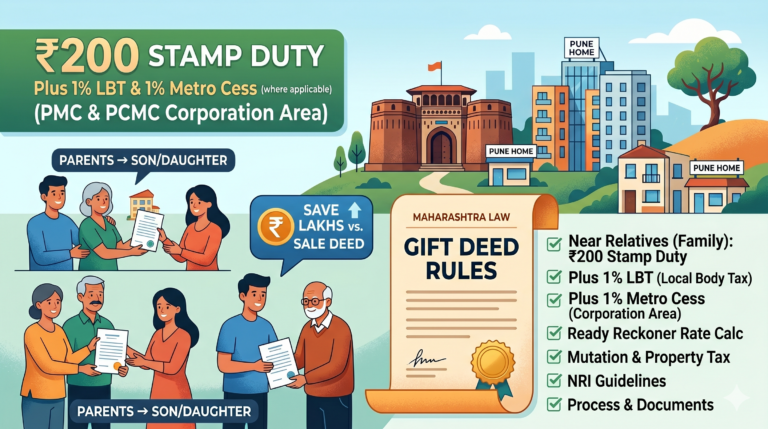
Will vs Gift Deed — Which is Right for You?
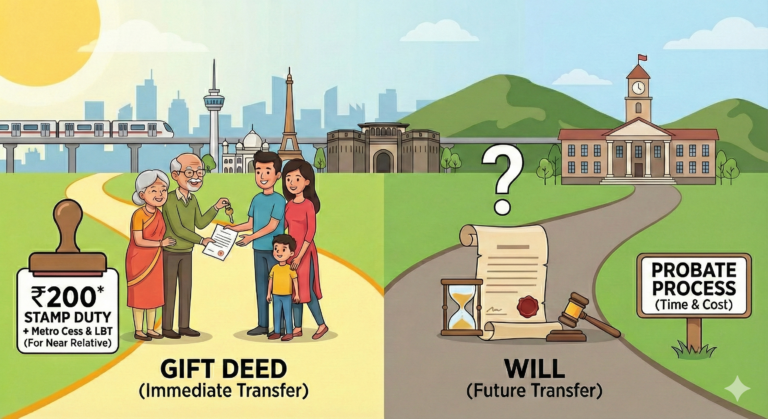
| Aspect | Will | Gift Deed |
|---|---|---|
| When it takes effect | After the testator’s death | Immediately upon execution |
| Ownership during lifetime | Testator retains full ownership | Transfers immediately to recipient |
| Revocable? | Yes — can be changed anytime | No — generally irrevocable |
| Stamp duty | Nil | Applicable (varies by property value) |
| Registration | Optional but recommended | Mandatory for immovable property |
A Will is generally preferred when the property owner wishes to retain full use and control of the property during their lifetime, while ensuring a smooth and legally clear transfer to chosen heirs after death.
Do You Need Probate in Pune?
Probate is a court process that verifies a Will’s authenticity and authorises the executor to manage the deceased’s estate.
Previously, under Section 213 of the Indian Succession Act, 1925, obtaining probate was mandatory for Hindus, Buddhists, Sikhs, and Jains whose Wills involved properties within the jurisdictions of the High Courts of Bombay, Calcutta, and Madras.
The Repealing and Amending Act, 2025, brought into force on 21 December 2025, has omitted Section 213 entirely. As a result, probate is no longer mandatory anywhere in India — including Pune and Mumbai.
Importantly, other provisions of the Indian Succession Act relating to probate, letters of administration, and succession certificates remain in force. Banks, cooperative housing societies, and government offices may still request such documents during property transfers, though they no longer have a strict legal basis to insist on them.
Practical takeaway: While probate is no longer compulsory, registering your Will remains the most reliable way to establish its authenticity — avoiding disputes, delays, and unnecessary court proceedings.
Frequently Asked Questions
Can I register a Will that was written years ago?
Yes. Unlike most documents, there is no time limit for registering a Will in Maharashtra. You may register it at any time — even decades after it was written.
Can I change or revoke a registered Will?
Yes. A Will remains fully revocable throughout the testator’s lifetime. A newer registered Will automatically supersedes an earlier one. You can also execute a formal Codicil (an amendment document) to modify specific provisions of your existing Will.
What is the registration fee & stamp duty for a Will in Pune?
The registration fee is just ₹100. Importantly, there is no stamp duty on a Will in Maharashtra.
Can a Will be registered at any Sub-Registrar office?
Yes. In Maharashtra, your Will can be registered at any of the 517 Sub-Registrar offices across the state — you are not restricted to the SRO of your residential jurisdiction.
What is a sealed Will deposit? How is it different from registration?
A sealed deposit allows you to keep the contents of your Will confidential while still securing it with the District Registrar. Unlike open registration, the contents are not disclosed until after your death, when the envelope is opened upon application.
Does an NRI need to register a Will in India?
If the NRI owns property in Pune or Maharashtra, it is strongly advisable to execute and register a separate Will in India to simplify succession for Indian assets.
Can two people make a joint Will?
Yes. A Joint Will involves two persons — often spouses — making a single testamentary document for mutual inheritance. It cannot be revoked unilaterally by one party after the other’s death.
Contact Us for Will Drafting & Registration in Pune
Our team of experienced professionals assists with end-to-end Will drafting, registration, and all property-related agreements and deeds in Pune — from the first consultation to the final registered document. We also handle Gift Deeds, Sale Agreements, Leave & Licence Agreements, Power of Attorney, and all other property documentation.
If you’d like to get started, contact us today.
Disclaimer: This article is for informational purposes only and does not constitute legal advice. Please consult a qualified legal professional for advice specific to your situation.