Importance of Agreement to Sell in Resale Property Transactions
Resale property deals in Pune move fast. A buyer likes a flat, the seller wants a quick closure, and both sides are often tempted to go straight to the Sale Deed to save time and one round of drafting. An Agreement to Sell, executed before the Sale Deed, is not paperwork for its own sake. It is the document that actually protects both parties while the deal is being completed.
What makes resale transactions different
A resale property already has an existing chain of title, an existing occupant, existing dues, and often an existing loan or society formalities to clear. Unlike a fresh purchase from a builder, where the developer’s documentation and RERA registration provide a baseline structure, a resale deal is negotiated entirely between two private parties, with no institutional framework backing the transaction.
This means the period between agreeing on a price and completing the sale carries real risk on both sides. The buyer needs time to arrange funds, verify the title, and secure a home loan if required. The seller needs certainty that the buyer will not walk away after documents are shared and the property is taken off the market. An Agreement to Sell is what manages this gap.
What an Agreement to Sell actually does
An Agreement to Sell is a contract to complete the sale at a future date, once specified conditions are met. It is not itself a transfer of ownership. Ownership continues with the seller until the Sale Deed is executed and registered. This distinction is the entire reason the document matters.
In a resale transaction, this gap period typically involves several steps that cannot be rushed: verification of the seller’s title through search and Index II records, confirmation that outstanding society dues, property tax, and electricity bills are clear, obtaining society NOC, checking for RERA compliance where applicable, arranging the buyer’s home loan and the bank’s own due diligence, and clearing any existing mortgage or charge on the property before or at registration. An Agreement to Sell lets both sides commit to the transaction while these steps are completed, without either party losing their position if something goes wrong along the way.
Why skipping the Agreement to Sell is risky
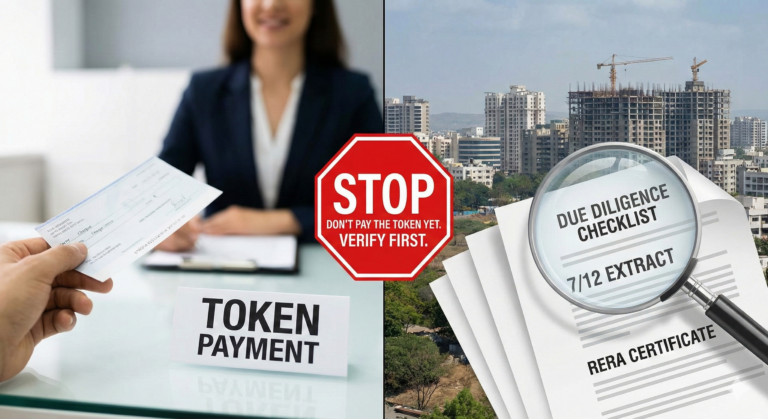
For the buyer: without a signed Agreement to Sell, a seller who receives a better offer, or simply changes their mind, is under no binding obligation to complete the sale. Any token amount paid without a proper agreement is difficult to recover, and the buyer has no clear right to specific performance since there is no enforceable contract on record.
For the seller: without a signed Agreement to Sell, a seller who takes the property off the market and shares documents has no protection if the buyer delays indefinitely, fails to arrange finance, or backs out after the seller has already made other commitments, such as booking a new property with the sale proceeds. A properly used Agreement to Sell avoids this altogether, because it keeps the transfer itself, not just the payment, conditional on the agreed terms being met.
Essential clauses for a resale Agreement to Sell
Every Agreement to Sell I draft for a resale transaction addresses the following, tailored to the specific property:
Total consideration and payment schedule. The full price, the amount paid as token or earnest money at signing, and the schedule for remaining payments, tied to specific dates or milestones.
Condition of title. A representation by the seller regarding clear and marketable title, existing encumbrances if any, and an undertaking to clear them before the Sale Deed.
Timeline for completion. A defined period within which the Sale Deed must be executed and registered, along with what happens if that period needs extension.
Default and forfeiture terms. What happens if the buyer fails to pay, typically forfeiture of the earnest money, and what happens if the seller fails to complete the sale, typically refund of amounts paid with interest, or in some cases the buyer’s right to seek specific performance.
Possession terms. Whether possession is being handed over before the Sale Deed or only at registration, since this materially changes the risk profile for both sides.
Document checklist. Confirmation of which documents the seller will provide, including the earlier Sale Deed or Gift Deed or Conveyance Deed, etc. with Index II, society NOC or Builder NOC as applicable, latest tax and electricity receipts, occupation certificate or possession letter, RERA certificate if available, and PAN and Aadhaar of all parties.
Stamp duty on the Agreement to Sell. In Maharashtra, an Agreement to Sell where possession is handed over is treated as conveyance for stamp duty purposes under Article 25 of Schedule I of the Maharashtra Stamp Act 1958, and the duty paid at this stage is adjusted against the duty payable on the subsequent Sale Deed.
A note for NRI buyers and sellers
Resale transactions involving NRI parties carry the same risks with added timing pressure, since coordination across time zones and jurisdictions often stretches the gap between agreement and registration. A properly drafted Agreement to Sell, with realistic timelines built around visa or travel plans, Power of Attorney arrangements where a representative signs on the NRI’s behalf, and RBI and FEMA considerations for the payment route, is particularly important in these cases to avoid disputes arising purely from delay rather than any real disagreement between the parties.
Frequently asked questions
Is an Agreement to Sell legally required before a resale Sale Deed in Pune? It is not mandatory by law, but it is strongly advisable. Without it, neither party has an enforceable commitment during the period between agreeing on the deal and completing registration, which is when most resale disputes arise.
Does an Agreement to Sell transfer ownership of the property? No. An Agreement to Sell is a contract to transfer ownership in future, subject to agreed conditions being fulfilled. Ownership remains with the seller until the Sale Deed itself is executed and registered.
What happens if the buyer pays a token amount without a written Agreement to Sell? Recovery becomes difficult and uncertain, since there is no enforceable contract recording the terms of the payment or the seller’s obligations. A written and properly stamped Agreement to Sell is essential even for token or earnest money payments.
Is stamp duty payable on an Agreement to Sell in Maharashtra? Under Article 25 of Schedule I of the Maharashtra Stamp Act 1958 stamp duty is payable, which is then adjusted against the duty on the final Sale Deed.
Can a seller back out after signing an Agreement to Sell? Not without consequence. A validly executed Agreement to Sell is a binding contract. A seller who defaults is typically liable to refund amounts received with interest, and depending on the terms and circumstances, the buyer may also have a right to seek specific performance of the contract.
This article is for general information and does not constitute legal advice. If you are buying or selling a resale property in Pune, consult a property lawyer before making any payment or signing any document.