Cancellation Clause in Rental Leave & License Agreement
When IT professionals review a contract—whether it is a software vendor agreement or an employment offer—they always look for the “Exit Clause.”
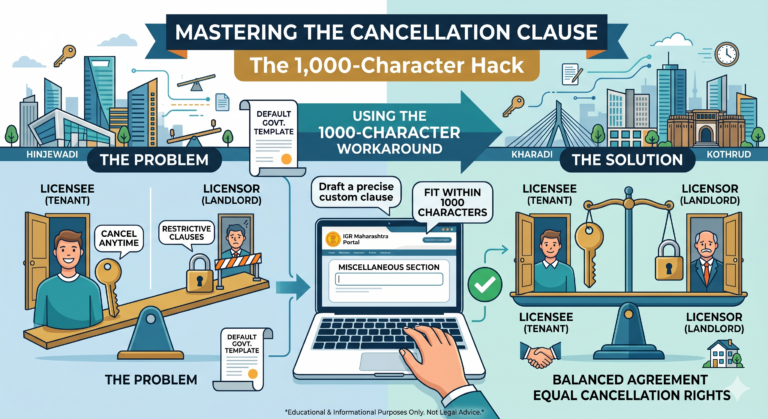
In the standard Leave and License Agreement generated by the Maharashtra Government portal, the Exit Clause (Clause 9) is highly unusual because it is asymmetric. Without a Lock-in period, the rules for leaving are completely different for the tenant and the owner.
Here is the exact legal text, and what it means for you in plain English.
The Legal Clause (Clause 9: Cancellation)
“That, if the Licensee commits default in regular and punctual payments of monthly compensation as herein before mentioned or commit/s breach of any of the terms, covenants and conditions of this agreement or if any legislation prohibiting the Leave and License is imposed, the Licensor shall be entitled to revoke and / or cancel the License hereby granted, by giving notice in writing of one month and the Licensee too will have the right to vacate the said premises by giving a notice in writing of one month to the Licensor as mentioned earlier.”
Decoding the Clause
If we translate this into simple words, this clause grants “Termination for Convenience” to the Tenant, but restricts the Owner to “Termination for Cause.”
1. The Tenant’s Power: Termination for Convenience Look closely at the last line: “…and the Licensee too will have the right to vacate the said premises by giving a notice in writing of one month…”
- What it means: As a tenant, you don’t need a “reason” to leave. You can wake up one morning, decide you want to move closer to your office in Hinjawadi, drop a 1-month notice to the owner, and walk away legally. You have the freedom to terminate for your own convenience.
2. The Owner’s Restriction: Termination for Cause Now look at the first half of the clause regarding the Licensor (Owner). They can only give you a one-month notice IF:
- You default on your rent payments.
- You breach the terms of the agreement (e.g., you start a commercial business in the house, or cause a nuisance).
- The government passes a new law prohibiting the arrangement.
- What it means: The owner cannot just ask you to leave. Unless you break a rule or stop paying rent, the owner’s hands are tied until the agreement period naturally expires.
Why Does This Matter?
Many tenants live in constant fear that the landlord might suddenly ask them to vacate within 30 days, leaving them scrambling to find a new home.
However, if your agreement uses this exact standard phrasing (and you haven’t added a “Lock-in” or a custom mutual-cancellation rule in the Miscellaneous section), the law protects your stability.
Summary for Tenants: As long as you pay your rent on time and follow the society rules, your landlord cannot legally trigger this cancellation clause to evict you before your term ends. You, however, hold the “Kill Switch” and can leave with just a one-month notice anytime.